

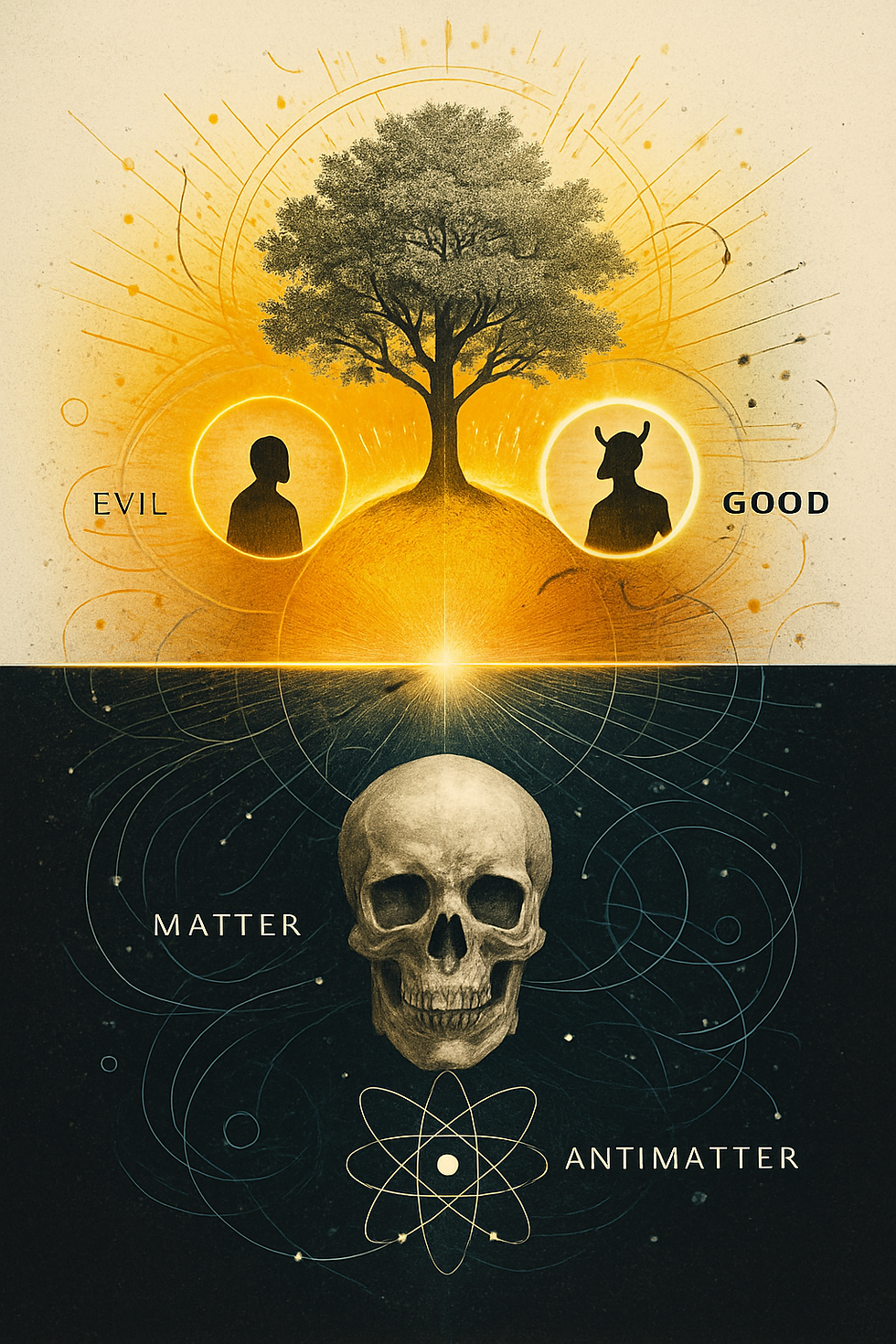
Death cannot exist without life, while life can exist perfectly well without death.
- Sep 20, 2025
- 2 min read
Death is entirely dependent on life for its existence. There can be no death without something first being alive. Death is not a force or entity—it's simply the cessation of biological processes. It's what we call the moment when life stops, but it has no independent reality beyond that ending.
Life, on the other hand, requires no death to exist. A single-celled organism that reproduces by division technically never dies, it just becomes two organisms.
Theoretically, biological processes could continue indefinitely without ever encountering death.
Life is a positive state of organization, energy, and activity. Death is merely the absence of those things.
This means death is actually the weaker force in this relationship. Death is parasitic on life, it can only occur where life has already established itself.
Death is not life's equal opponent; it's life's shadow, entirely dependent on life for its very possibility.
Consider what this asymmetry reveals about existence itself. We often frame life as a temporary interruption in an otherwise dead universe, but this gets it backwards.
The universe spent billions of years without any death because there was nothing alive to die. Death only became possible when life emerged and created the conditions for its own ending.
Life is the creative force, it builds complexity, organizes matter, generates new possibilities. Death is simply the breakdown of what life has built.
Death creates nothing, generates nothing, organizes nothing. It only undoes what life has already accomplished.
Yet we've somehow convinced ourselves that death is the more powerful force. We structure philosophies around death's inevitability and treat it as the ultimate reality that gives meaning to everything else.
But death has no meaning independent of life, it's only significant because it represents the end of something that was previously significant.
This reversal in our thinking might stem from death's apparent finality. Because death seems permanent and irreversible, we assume it must be the stronger force.
But permanence doesn't equal strength, it just means that once life's organizing processes stop, they require new energy and information to restart.
Life is the active principle in this relationship. Life does the work, creating, organizing, maintaining, reproducing.
Death simply represents the moment when life stops doing that work. It's like calling darkness powerful because it lasts forever when you turn off a light. Darkness isn't conquering light; it's just what remains when light stops operating.
Understanding this asymmetry changes how we might think about mortality and meaning. Instead of seeing life as a brief spark in an eternal darkness, we might recognize that death is only possible because life creates the conditions for its own ending.
Death needs life to exist, but life could theoretically exist without ever encountering death.
The real power belongs to whatever force can organize matter into complex, self-maintaining, reproducing systems capable of experience and action. Death is just what we call it when that organization breaks down.
The breakdown isn't stronger than the organization, it's entirely dependent on it.
Life makes death possible. Death makes nothing possible, it simply ends possibilities that life has already created.


Comments